How to Cut Down a Tree: Safety First
If you are looking up how to cut down a tree, start with the ground it will hit, not the saw. On a typical Denver lot the tree is taller than the space between the house, the fence, the sidewalk, and the neighbor's roof. A trunk that looks straight from the driveway can still pull toward a heavy limb, a lean, or a weak fork. Once the cut is open, you do not get a second try.
Most of the time the useful question is not which notch to cut. It is whether this tree, in this yard, can come down in one piece without crossing a line, a roof, or a person. If the answer is no, stop and get a crew to look at it.
Call for a free estimate at 303-803-3850, or send the form and we will look at the tree with you.
Decide if this tree should come down at all
Cutting a tree down is the last option, not the first. A dead top, a split fork, or a limb over the roof can often be handled with pruning. Disease and insects are the same: some trees can be treated, and some cannot. Nobody can honestly promise a tree will be saved. That depends on its condition, the care it gets afterward, and the weather.
Removal makes more sense when the trunk is failing, the roots have lifted, or the tree is already hitting a structure and pruning will not fix the problem. A tree that has leaned for years is different from one that leaned after a storm. A new lean, cracked soil, or a lifted root plate is a reason to stay back and call, not a reason to start a cut.
If the tree is damaged, hanging, or on a wire, that is a different job from a planned removal. Read the emergency tree removal guide before you walk under it. Do not brace it, pull it, or start a chainsaw on it.
Walk the drop zone before you think about a cut
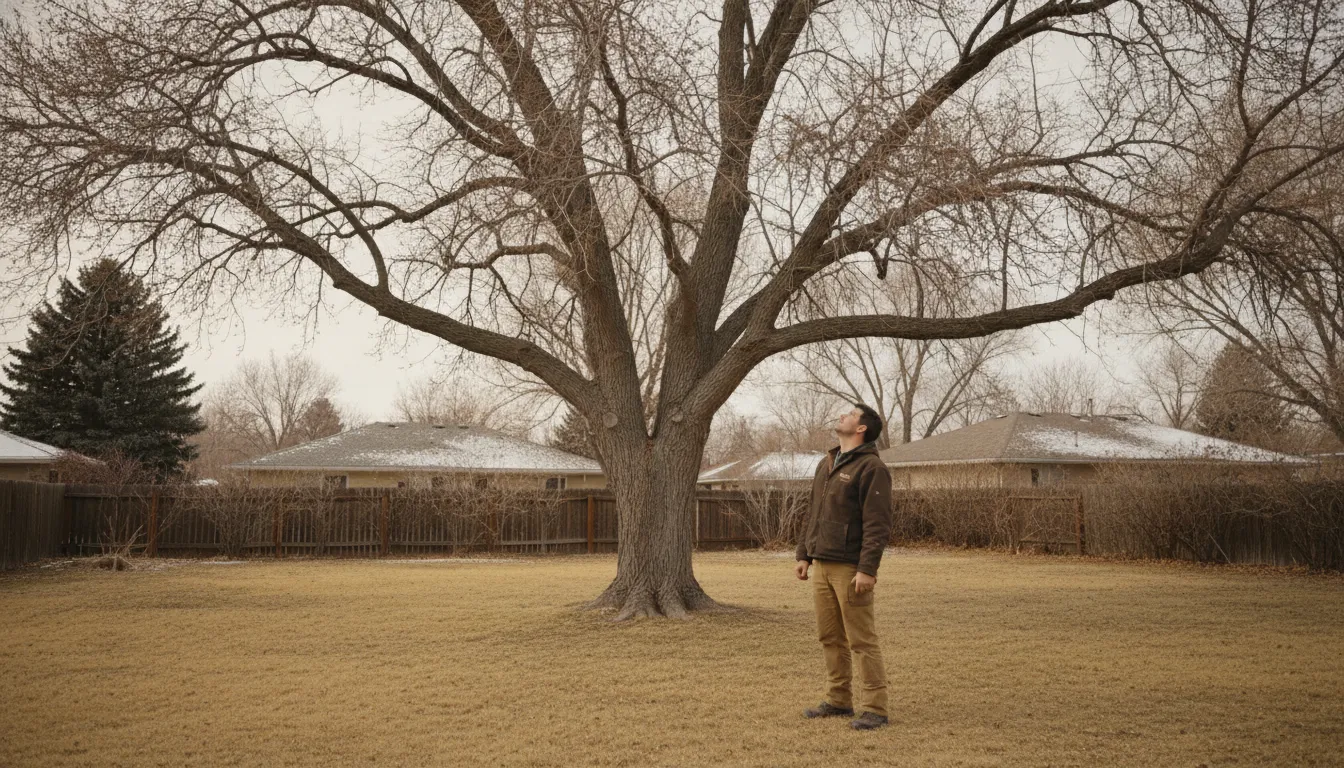
Stand where the tree would land and look up. The drop zone is not a neat circle the width of the trunk. A tree can kick backward off the stump, a limb can break on the way down, and the top can swing if it catches another branch. Texas workplace guidance for tree crews says the marked drop zone should reach at least twice the height of the piece being cut. Ground workers should stay beyond the height of the tree. A homeowner with a saw and no spotter has less room than that, not more.
Measure the height against the yard, not against a guess. A simple check is to walk away from the trunk until you can sight the top, then compare that distance to the open grass. If the open space is shorter than the tree, the tree cannot fall in one piece inside the yard. Roofs, fences, parked cars, play sets, and the neighbor's property all count as occupied, even if nobody is standing there right now.
Also look at what you cannot move. Overhead lines, a steep slope, a retaining wall, and wet or icy Front Range ground all change the plan. Wind matters the day of the work. A calm morning and a gusty afternoon are not the same job.
What you see | What it means | What to do |
Open lawn longer than the tree. No wires. Sound trunk. | A ground cut might stay inside the yard. | Still plan the fall direction. Keep a way to step clear. |
Tree taller than the gap to a house, fence, or sidewalk. | The top will not stay in the yard in one piece. | Stop. The wood has to come down in pieces. |
Lean, crack, hollow, or a limb hung in another tree. | The trunk may not fall where you aim it. | Stay out from under it. Have an arborist look first. |
Any overhead line near the crown, or a limb on a wire. | Contact can travel through the tree, a tool, or a branch. | Do not cut. Call the utility. |
No truck access. Steep ground. A deck in the way. | Pieces have to be lowered, not dropped. | This is a crew job. It needs a climb or a bucket, not a ground saw. |
How to cut down a tree without guessing the fall
Tree cutting is one of the more dangerous jobs in outdoor work because the hazards stack. You are using a saw at the base of something heavy, often on uneven ground, sometimes near wires. The Texas Department of Insurance groups the serious outcomes as falls, electrical contact, being struck by wood, and chainsaw injuries. Those are crew injuries, with training and a second person watching. They are not a reason to try the same work alone on a Saturday.
- Power lines.
Treat every overhead line as live. OSHA warns that electricity and tree work are a deadly mix, including contact through a branch, a ladder, or a tool. Stay far back and call the utility. Do not cut a limb that could swing into a line, and do not touch a tree that is already on a wire.
- The fall itself.
Lean, a heavy side of the crown, rot in the trunk, and a hang-up in a nearby tree can all send the trunk somewhere other than the open lawn. A barber-chair split can throw wood back at the person holding the saw.
- The saw and the ground.
Kickback, a pinched bar, and a trunk under tension are common ways people get hurt. Loose dogs, kids, and a helper standing "just behind" the sawyer are inside the wrong zone.
- Access.
A gate that blocks a truck, a locked side yard, or a deck around the trunk means the wood has to be lowered in pieces. That is climbing and rigging work, not a ground cut.
If any of those are true, stop. The safe version of how to cut down a tree is to leave the cutting to a crew. They bring the equipment and a plan for where every piece goes.
What to check before anyone starts cutting
A careful crew does not start with the chainsaw. They walk the site, name the hazards, and agree on the direction of the fall and a way out. You can do the homeowner half of that walk before you call, and it makes the estimate more useful.
Confirm the tree is yours. A trunk on the property line, or limbs over a neighbor's roof, is a conversation before it is a cut. Do not assume a shared tree is yours to fell.
Ask the city or HOA whether removal needs approval. Rules differ across Denver, Lakewood, Aurora, Arvada, and other nearby cities, and some HOAs want notice before a mature tree comes out. We work across the Denver metro and can travel farther for a large enough job. We do not take work in Boulder, deep into the mountains past Morrison and Golden, or south past Parker and Elizabeth.
Note wires, roofs, fences, irrigation, and anything under the canopy. Photos from several sides help. Say whether a truck can reach the tree or whether the crew would be carrying wood out by hand.
Look for defects you can see from the ground: a hollow, a deep crack, fungus at the base, a hanging limb, or a lean that showed up recently. Stay out from under the canopy while you look.
Decide what should happen to the wood and the stump before the work starts. Stump grinding is not part of every removal. Replacement planting is optional and is quoted on its own. On our jobs we recycle the wood we cut, and we can talk through firewood or planting if you want either one.
That list is the planning work. It is not a felling method. Notch angles and back cuts belong in training, on a site that has room for an escape path. They do not belong in a backyard tutorial.
When to hand the job to a crew
Call for professional tree removal when the tree is taller than the open yard or leans toward a structure. Call when wires are near the crown, or when the trunk looks hollow, cracked, or hung up in another tree. Also call when you would need a ladder or a climb to get the weight off before the trunk can fall. If you are already unsure, that is the answer.
Natural Tree Care and Recycling removes trees for homeowners, business owners, and HOA managers around Denver, especially on older lots with mature trees. The crew uses bucket trucks and stump grinders when the site allows, and the wood from our own jobs is recycled rather than left as a general recycling pickup. A free estimate is a look at the actual tree and a scheduled visit, not a price list. New-client work is usually at least $500, with some flexibility for repeat clients or when we are already nearby. Storm damage and other urgent situations can be scheduled the same day when the situation calls for it. That is not a promise of round-the-clock coverage or a set arrival time.
Price depends on the tree in front of you. Size, access, what it could hit, and whether the stump is included all change the number. The Denver removal guide covers how those factors change a quote. Use it to know what you are comparing. Do not use it as a rate card. Two trees of the same height rarely cost the same.
Bring photos of the trunk, the crown, and the nearest roof or line when you call. Tell us whether a truck can reach the tree from the alley or only from the street. That is usually enough for us to say whether the visit is a straightforward removal or a piece-by-piece job. We would rather look once than have you start a cut and then stop halfway.
After the tree is down, the stump is a separate decision. Grinding and full stump removal do different jobs, and neither is automatic. If the stump is part of what you want gone, say so when you book the visit. Read stump grinding versus stump removal so you know which result you are asking for.
If the tree is too close, too tall, or near a line, request a free estimate. We will tell you what it will take to bring it down.
FAQ
Can I cut down a small tree myself?
Only if it is short enough to miss the house, the fence, and any line, and only if you can see a clear drop and a way to step away. A short tree with rot, a hang-up, or wires nearby is still the wrong tree to practice on. When you would not want a child or a pet in the yard while it falls, do not be the person under it with a saw.
Do I need a permit to remove a tree in Denver?
Sometimes. Cities and HOAs across the metro set their own rules, and a tree on a property line is not a simple yes. Check before anyone cuts. We can talk through what we see on site, but the approval is still yours to confirm.
What should I do if the tree is touching a power line?
Stop and call the utility. Do not cut, climb, or pull on any part of the tree, and do not touch a fence or a tool that might be in contact with it. Tree work near lines is a utility and line-clearance job, not a homeowner cut.
Is the stump included when you cut a tree down?
No. Stump grinding is a separate service unless the quote says it is included. Planting a replacement is also optional. Tell us if you want either one when you ask for the estimate.
How fast can someone come look at a tree?
Phones are answered Monday through Friday, 8:00 a.m. to 4:30 p.m. Mountain Time. For a tree that is an active hazard, including after a storm, we can often do same-day work when the situation calls for it. We do not promise a 24-hour response or a fixed arrival window.